

The ₹30 Lakh Day: How a Fandom Brand Structures Its Meta Spend
A pop-culture merchandise brand with a fixed daily revenue target and a fixed daily media budget. No second channel to lean on, no monthly averaging to hide behind. This is how the ad account was built to carry it.
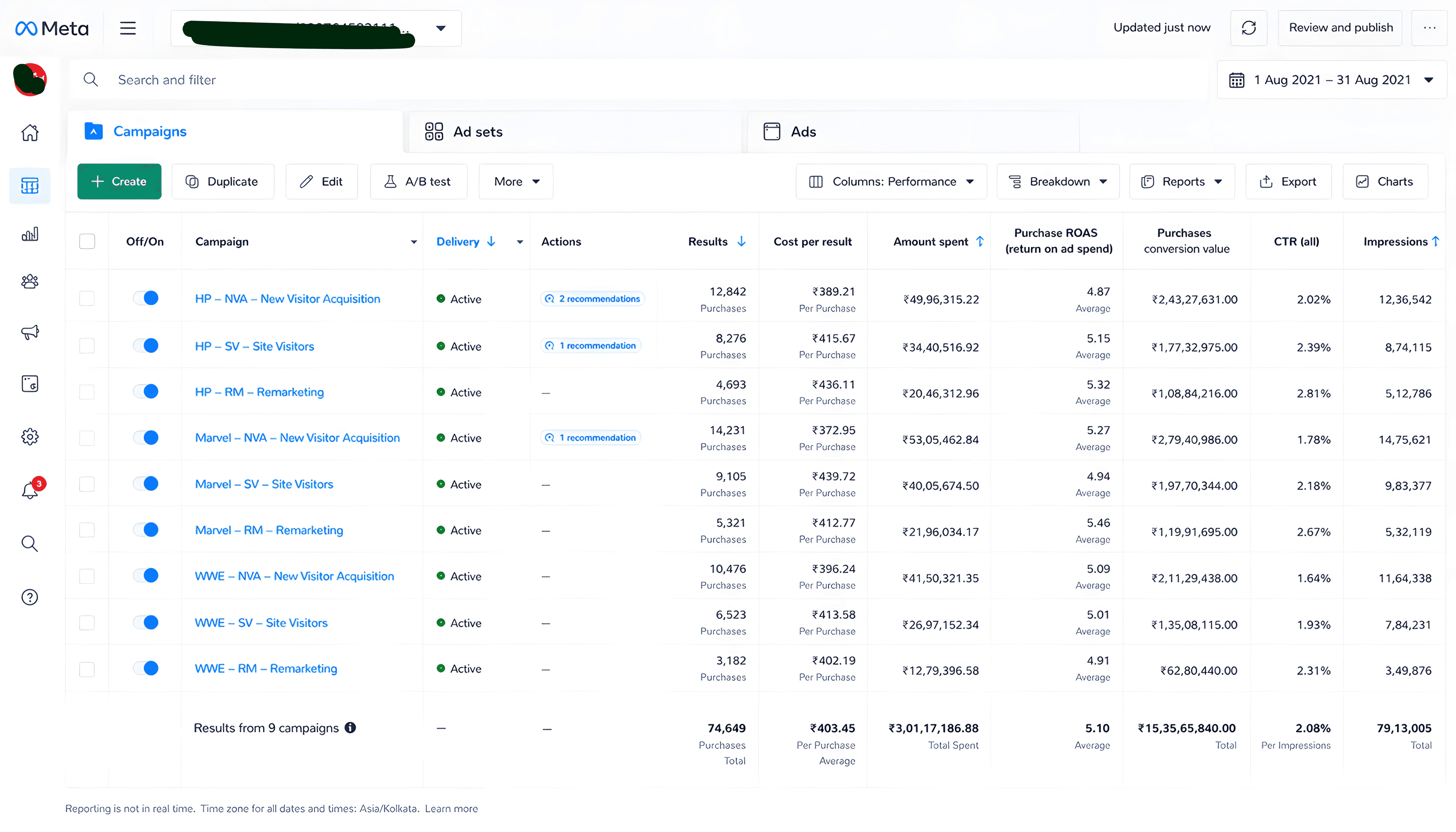
Project Mandate & Overview
- Client
- Confidential Brand
- Industry / Sector
- Licensed Merchandise & D2C Apparel
- Channels Managed
- Meta Ads Only
- Timeline / Period
- Account Architecture Teardown
- Core Brief
- ₹30L Daily Revenue on ₹6L Daily Meta Spend (5.0x ROAS)
01. The Mandate
Two numbers were fixed. Everything else had to bend.
Most briefs give you a target and let you find the budget. This one fixed both: ₹30 lakh of revenue a day against ₹6 lakh of Meta spend a day, with no other paid channel to fall back on.
Divide one by the other and the job becomes very simple to state and very hard to do. Every rupee spent had to bring back five. Not on average across a good month. Every single day.
Imagine a shop that must take ₹30 lakh across the counter today, and the only way to get people through the door is ₹6 lakh of ads. If you spend the ₹6 lakh badly on Monday, Monday is gone. You cannot make it up on Friday, because Friday has its own ₹30 lakh to find.
A daily target changes how you build an account. Monthly targets let you spend lazily for three weeks and rescue the month at the end. Daily targets remove that option. The account has to be arranged so that something reliable carries every day of the week, and so that no single audience or product is being asked to do all the work.
The rest of this document is the arrangement. It is not a list of tactics. It is a structure, and the structure is the reason the numbers were reachable.
In Plain Words
A daily target eliminates lazy spending. The account must be arranged so that something reliable carries every day of the week, and no single audience or product is asked to do all the heavy lifting.
02. The Core Idea
Every fandom was treated as its own brand
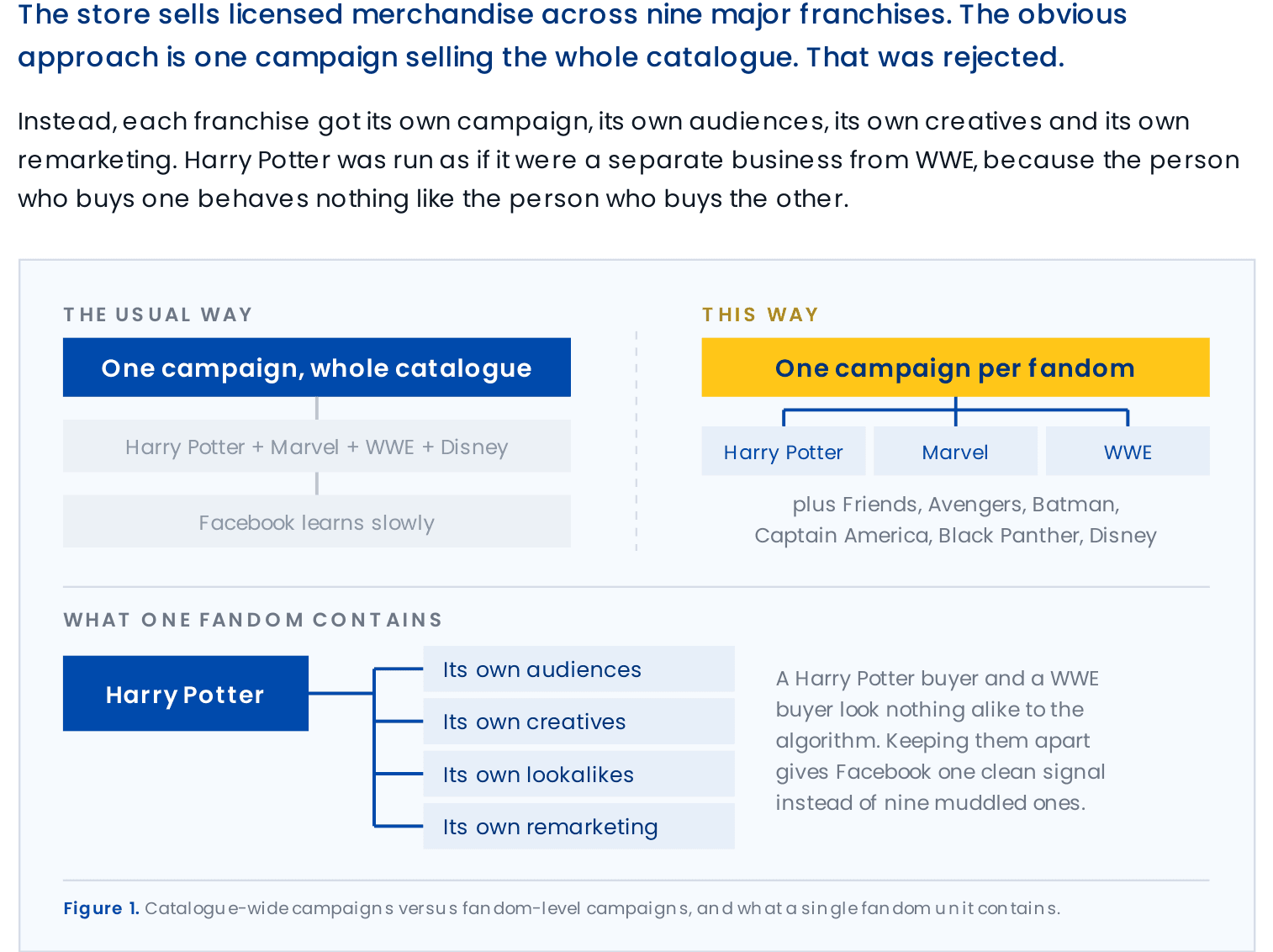
The store sells licensed merchandise across nine major franchises. The obvious approach is one campaign selling the whole catalogue (Harry Potter + Marvel + WWE + Disney together). That was rejected.
Instead, each franchise got its own campaign, its own audiences, its own creatives, and its own remarketing. Harry Potter was run as if it were a separate business from WWE, because the person who buys one behaves nothing like the person who buys the other.
A Harry Potter buyer and a WWE buyer look nothing alike to the algorithm. Keeping them apart gives Facebook one clean signal instead of nine muddled ones.
- Harry Potter: Dedicated seed lists, specific lookalikes, themed creatives & remarketing
- Marvel & Avengers: Action-driven creative angles, cinematic cutdowns, superhero fandom interests
- WWE: Distinct demographic segments and wrestling enthusiast targeting
- Friends & Disney: Lifestyle & nostalgia-focused audience hooks
In Plain Words
Think of nine small shops under one roof instead of one big shop with everything jumbled together. Each small shop knows exactly who its regulars are. The big shop knows nothing about anyone.
03. The Structure
Three campaigns, sorted by how well someone knows you
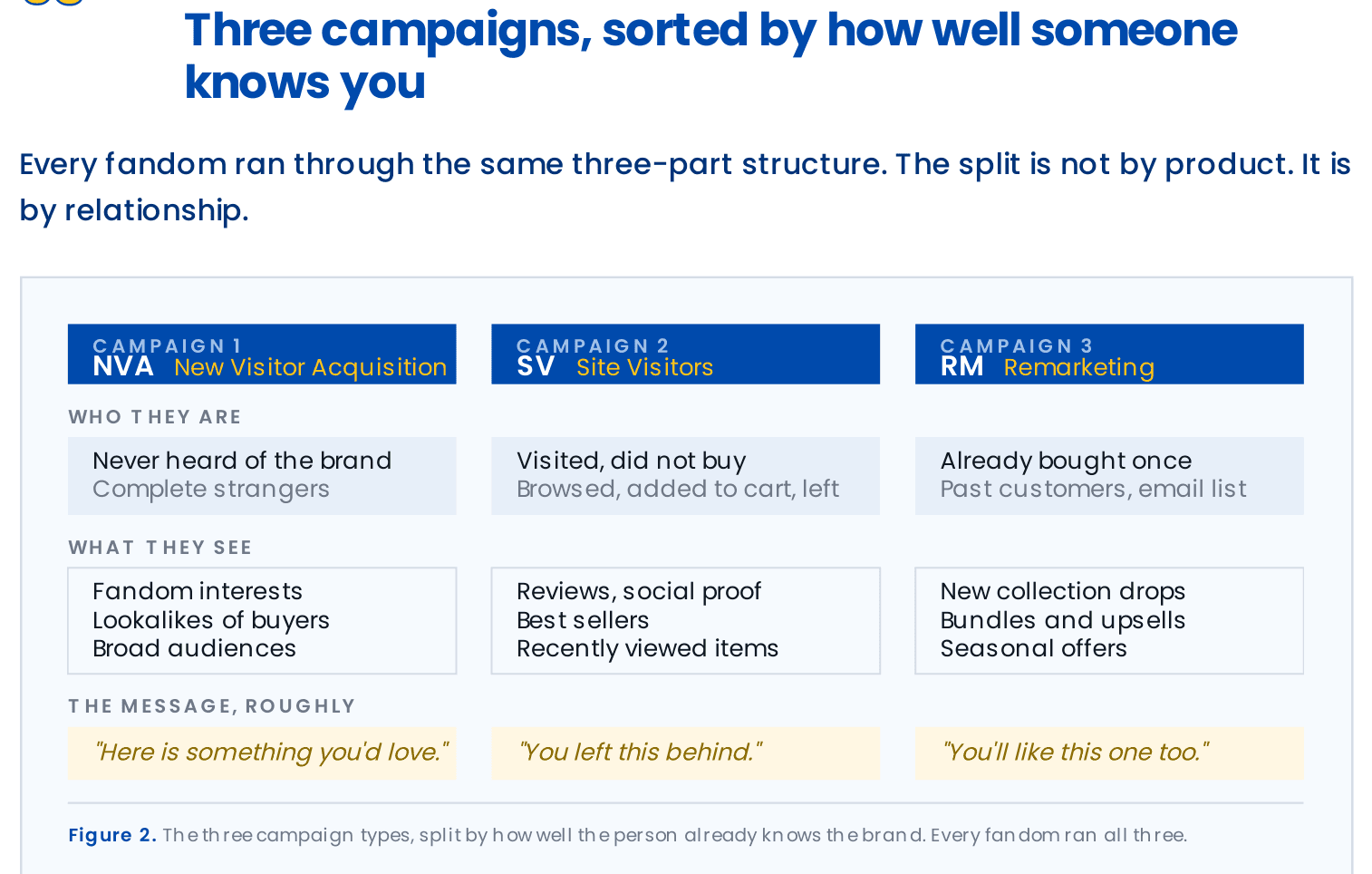
Every fandom ran through the same three-part structure. The split is not by product. It is by relationship.
In Plain Words
You do not greet a stranger, a browser, and a regular customer the same way. Campaign 1 introduces the brand. Campaign 2 nudges someone who nearly bought. Campaign 3 sells the next thing to someone who already trusts you. Mixing all three into one campaign wastes money on all three.
| Campaign Type | Who They Are | What They See | The Message, Roughly |
|---|---|---|---|
| Campaign 1: NVA (New Visitor Acquisition) | Never heard of the brand / Complete strangers | Fandom interests, Lookalikes of buyers, Broad audiences | "Here is something you'd love." |
| Campaign 2: SV (Site Visitors) | Visited, did not buy / Browsed, added to cart, left | Reviews, social proof, best sellers, recently viewed items | "You left this behind." |
| Campaign 3: RM (Remarketing) | Already bought once / Past customers, email list | New collection drops, bundles and upsells, seasonal offers | "You'll like this one too." |
04. Cold Audiences
The lookalike ladder, built per fandom
This was the sharpest part of the whole account. Most brands build one lookalike audience from all their buyers. This account built a separate ladder for every collection.
A lookalike audience is Facebook finding more people who resemble a group you give it. Feed it all your buyers at once and it averages them into a blur. Feed it only your Harry Potter buyers and it goes looking for more Harry Potter people.
Move up a rung only when the rung below is still profitable. Never skip rungs.
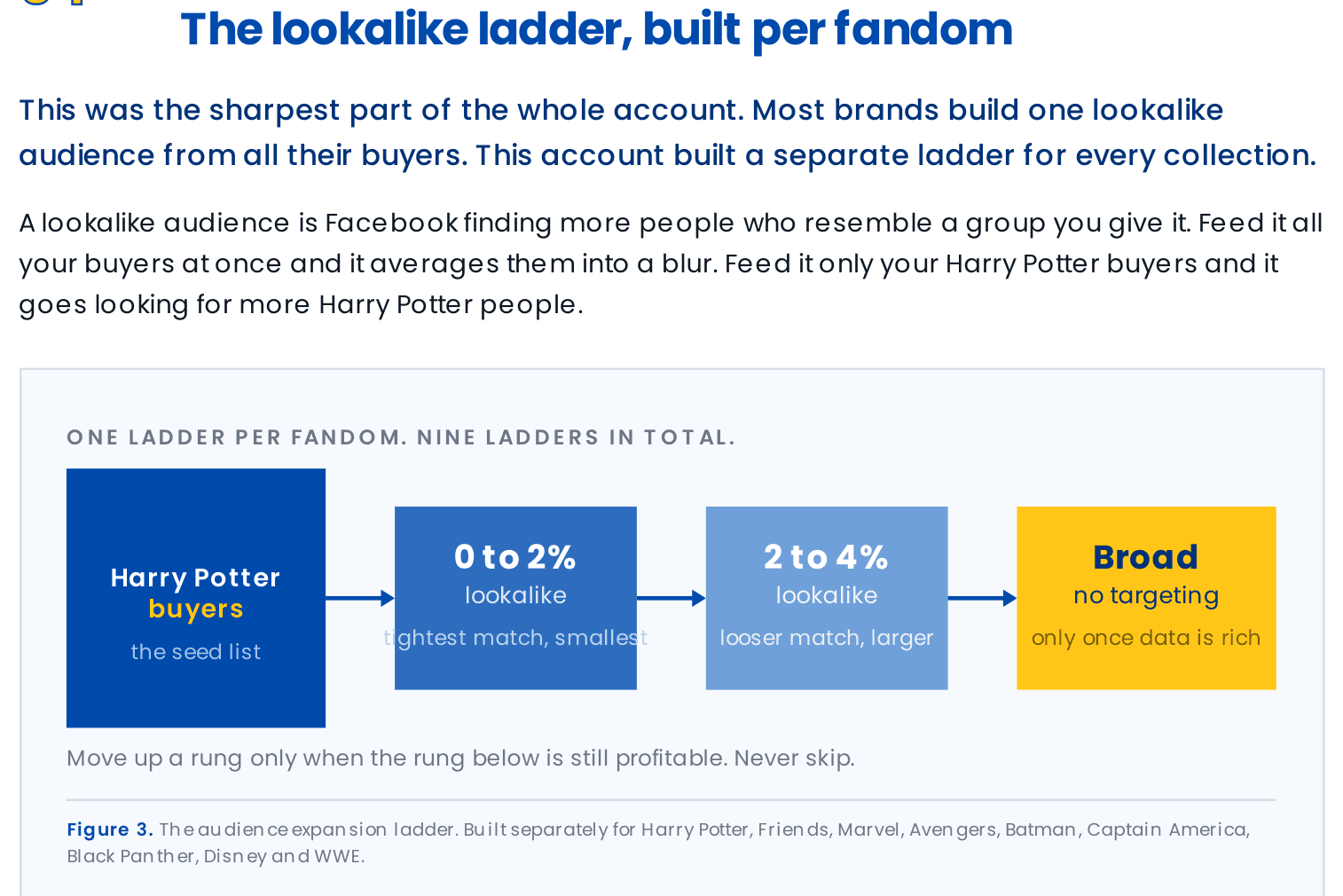
- 0 to 2% Lookalike: Tightest match, smallest pool. Highest conversion probability.
- 2 to 4% Lookalike: Looser match, larger pool. Unlocked once 0-2% saturates.
- Broad (No targeting): Unlocked only once purchase data on the pixel is exceptionally rich.
In Plain Words
Start with the people most like your best buyers. That pool is small but it converts. When it stops being able to spend your budget, step out to a slightly wider pool. Only when Facebook has learned enough do you take targeting off entirely and let it hunt. Going straight to the widest pool on day one is how most accounts waste their first month.
05. Existing Customers
Never sell someone the thing they already own
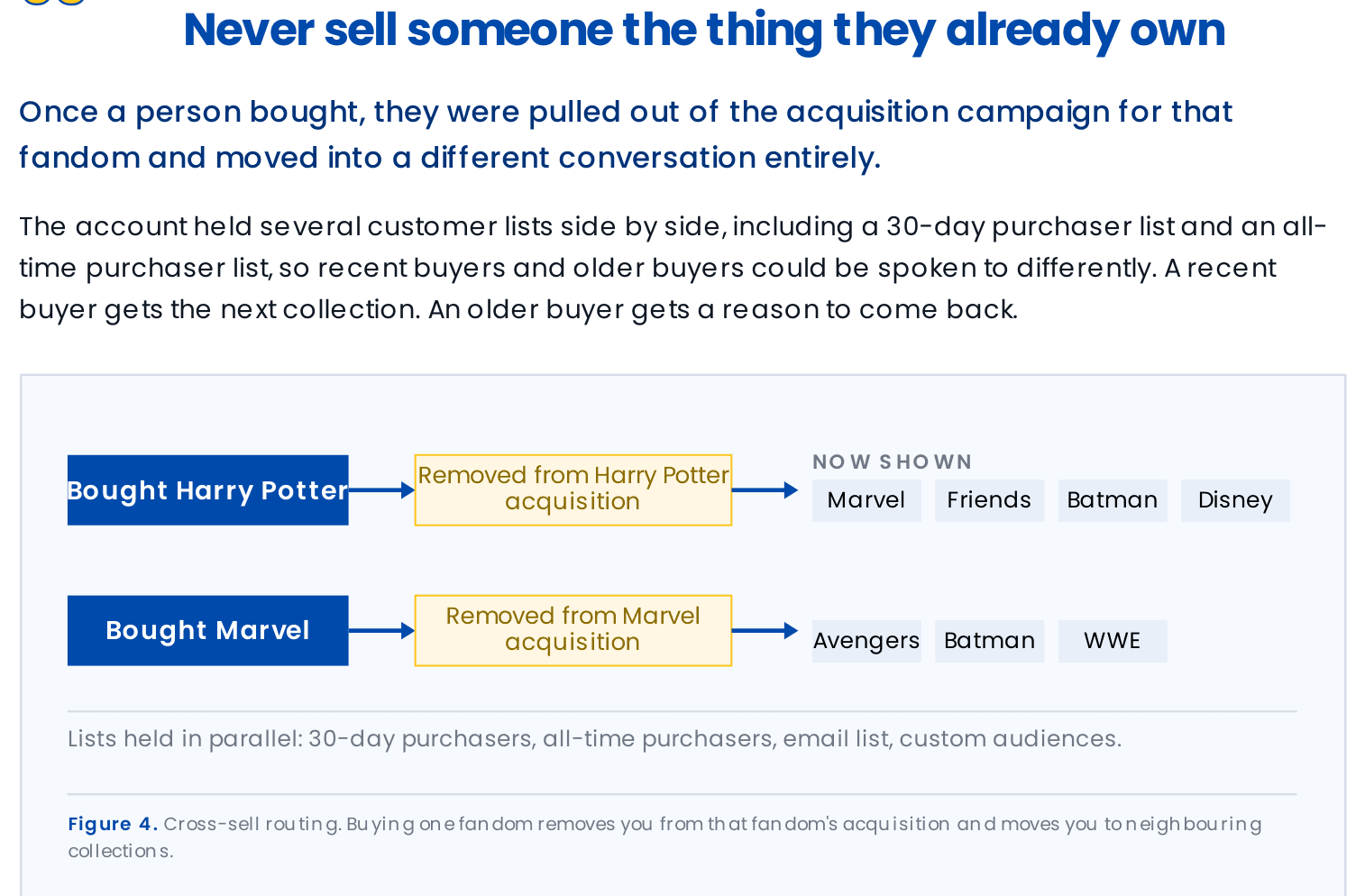
Once a person bought, they were pulled out of the acquisition campaign for that fandom and moved into a different conversation entirely.
The account held several customer lists side by side, including a 30-day purchaser list and an all-time purchaser list, so recent buyers and older buyers could be spoken to differently. A recent buyer gets the next collection. An older buyer gets a reason to come back.
In Plain Words
If a customer just bought a Harry Potter T-shirt, showing them the same T-shirt again for the next three weeks is money set on fire. Show them Marvel instead. The person has proven they buy fandom merchandise. The only question left is which fandom next.
06. The Whole Journey
From stranger to regular, in one picture
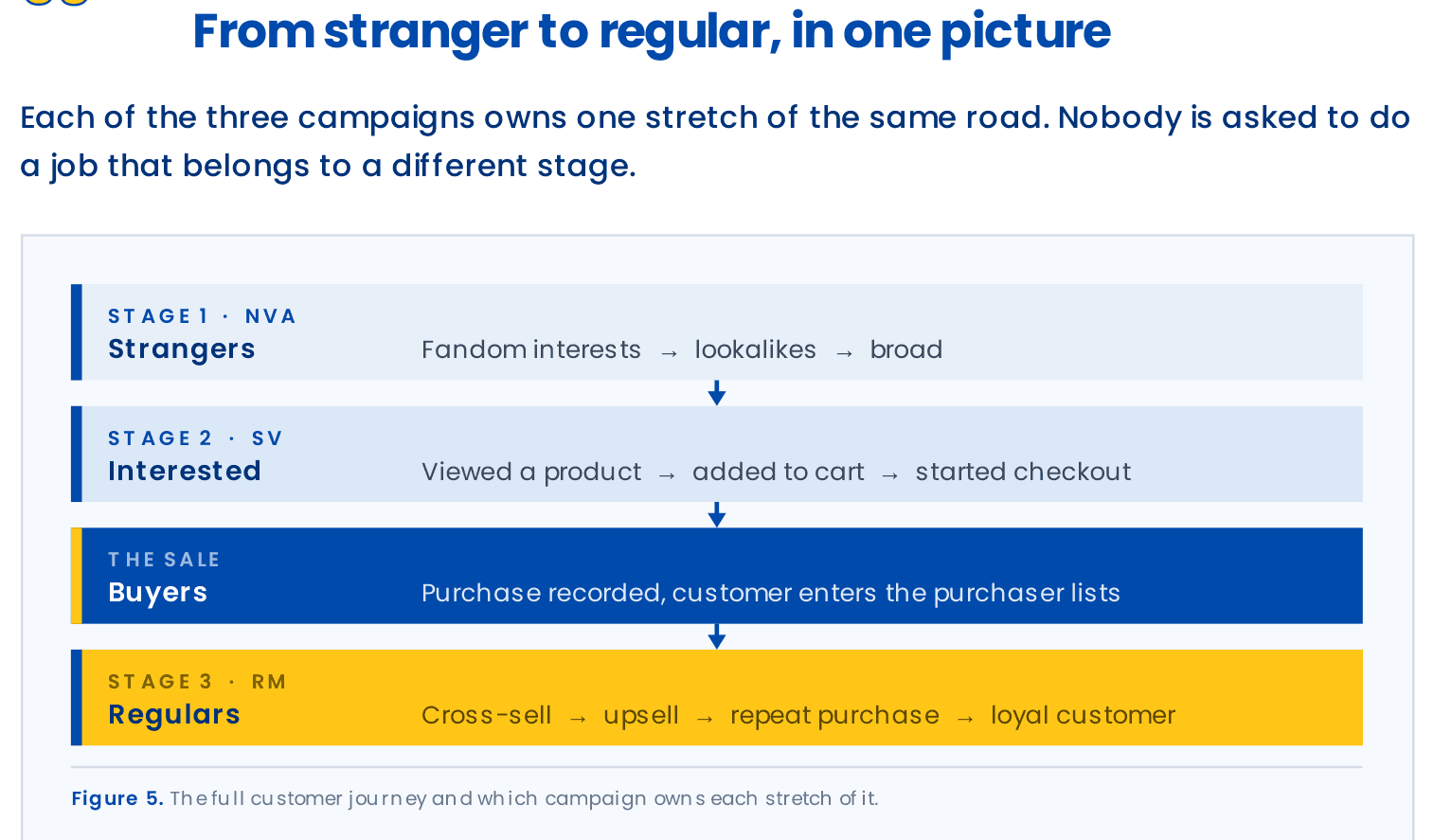
Each of the three campaigns owns one stretch of the same road. Nobody is asked to do a job that belongs to a different stage.
Stage 1 (NVA): Strangers (Fandom interests -> lookalikes -> broad).
Stage 2 (SV): Interested (Viewed product -> added to cart -> started checkout).
The Sale: Purchase recorded, customer enters purchaser lists.
Stage 3 (RM): Regulars (Cross-sell -> upsell -> repeat purchase -> loyal customer).
In Plain Words
The point of drawing it this way is that no stage is skipped and no stage is doubled up. Money spent on strangers is judged on whether it creates browsers. Money spent on browsers is judged on whether it creates buyers. Money spent on buyers is judged on whether they come back. Three different jobs, three different scorecards.
07. The Weekly Rhythm & Product Separation
A different reason to buy every day of the week, with strict product categories
Nothing ran forever. The offer changed almost daily, which is how a fixed daily target gets carried without exhausting the same audience with the same message.
Monday: Exclusive deal. Tuesday: Full sleeve collection (₹299). Wednesday: Flat full sleeve (₹399). Thursday: Female exclusive tee dress (₹299). Friday: All T-shirts (₹339). Saturday: Winter wear sale. Sunday: Best sellers rotated.
Three things happen when the offer rotates on a fixed schedule: Creatives stay fresh so CTR holds up; returning customers see something new each visit; and the account never becomes dependent on one hero product.
Apparel and mobile accessories were never mixed. Batman LED covers, Captain America LED covers, phone stickers, and plain covers had dedicated structures. A ₹299 phone cover buyer and a ₹999 hoodie buyer are different people with different triggers.
08. Scaling Architecture
What happened when something worked: horizontal expansion first
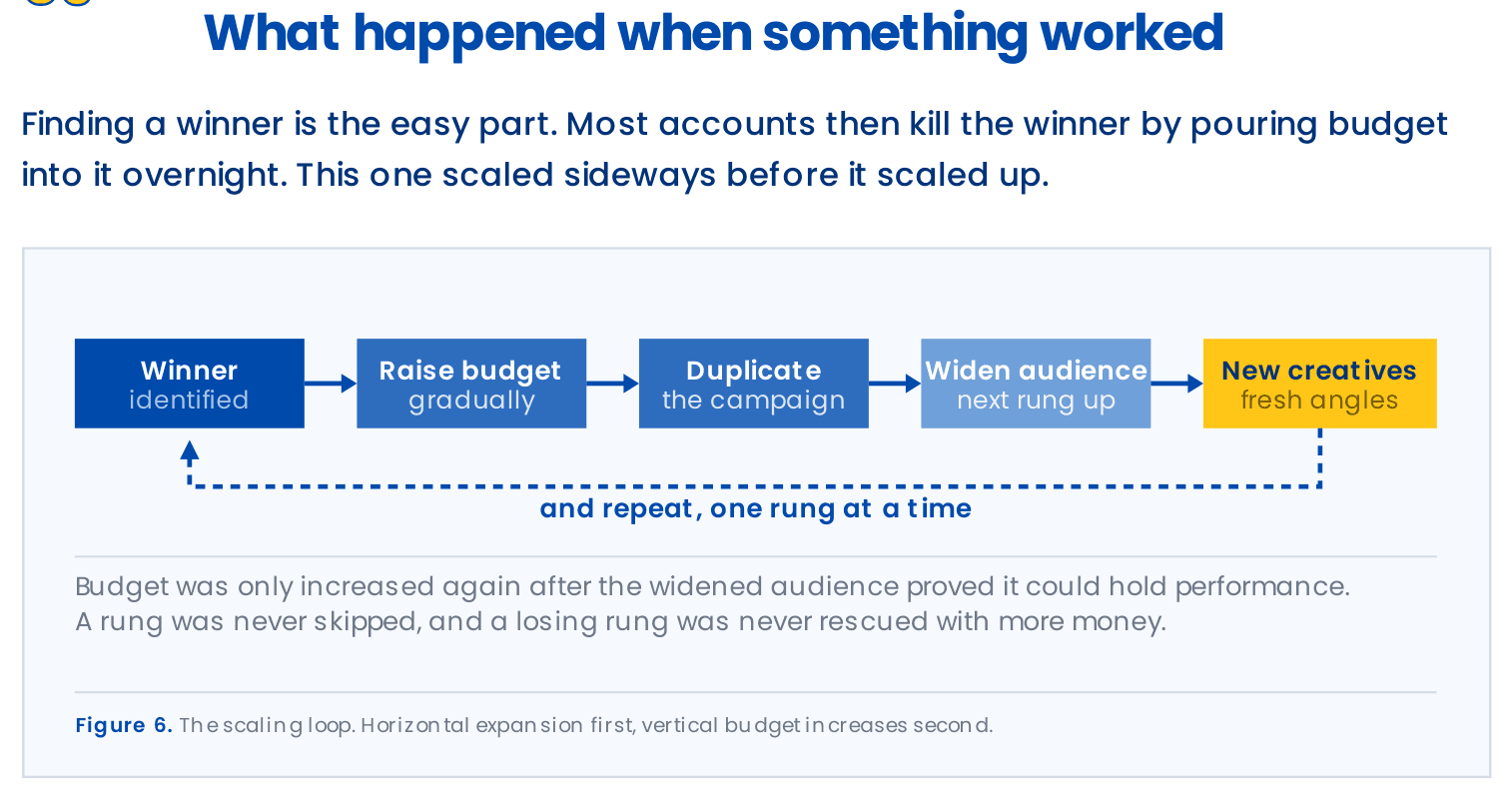
Finding a winner is the easy part. Most accounts then kill the winner by pouring budget into it overnight. This one scaled sideways before it scaled up.
When a winner was identified, we raised budget gradually, duplicated the campaign, widened the audience to the next rung up (e.g. 0-2% to 2-4%), and introduced fresh creative angles.
Budget was only increased again after the widened audience proved it could hold performance. A rung was never skipped, and a losing rung was never rescued with more money.
In Plain Words
If a campaign is doing well on ₹10,000 a day, tripling it to ₹30,000 overnight usually breaks it, because Facebook has to relearn everything at the new spend level. Copying the campaign and opening it to a slightly bigger audience adds spend without resetting what the system already knows.
Data & Sourcing Note: This is a structure teardown documenting account architecture. Targets of ₹30,00,000 daily revenue on ₹6,00,000 daily spend represent operating design criteria. Reconstructed from contemporaneous campaign planning notes.
Key Strategic Principles
- 1Split the account by customer relationship, not just by product: Strangers, browsers, and past buyers get separate campaigns so none hides a bad result inside a good average.
- 2Give every collection its own everything: Own audiences, own creatives, own lookalikes, own remarketing. The algorithm learns faster from one clean signal than from nine mixed ones.
- 3Build lookalikes from the specific, not the general: A lookalike made from all buyers describes nobody. A lookalike made from Harry Potter buyers describes someone Facebook can actually find.
- 4Widen in steps, never in leaps: Tight audience (0-2%) first, wider (2-4%) second, broad no-targeting last, and only once there is enough dense purchase data.
- 5Stop selling people what they own: A purchase should move someone out of that fandom acquisition into neighbouring collections. Repeat revenue is cheaper, but only if the offer changes.
- 6Rotate the offer on a schedule: A fixed weekly calendar keeps creatives fresh, protects click-through rates, and stops the daily target from depending on a single hero product.
More Work
Explore other growth stories
How Umi Matcha Turned a Niche Tea Into Repeatable Revenue
A D2C ceremonial matcha brand selling stone-ground Japanese green tea in an unfamiliar market. Ninety days of paid social, organic search and funnel repair delivered 12,000 reached users, a 22.7x test ROAS, and a compounding subscription base that runs without a discount.
2640% Revenue Increase and 541% ATC Growth for a Clothing Brand
A fast-growing clothing brand came in at ₹10,000–₹50,000 monthly revenue. Full-funnel Meta campaigns took monthly revenue to ₹13,72,369, with 12,807 adds to cart and 2,394 purchases.
Imagine having an in-house creative lab testing 40+ winning ad hooks every month.
Stop watching customer acquisition costs double from creative burnout. The next step takes 15 minutes and could unlock your most profitable scaling quarter yet.